
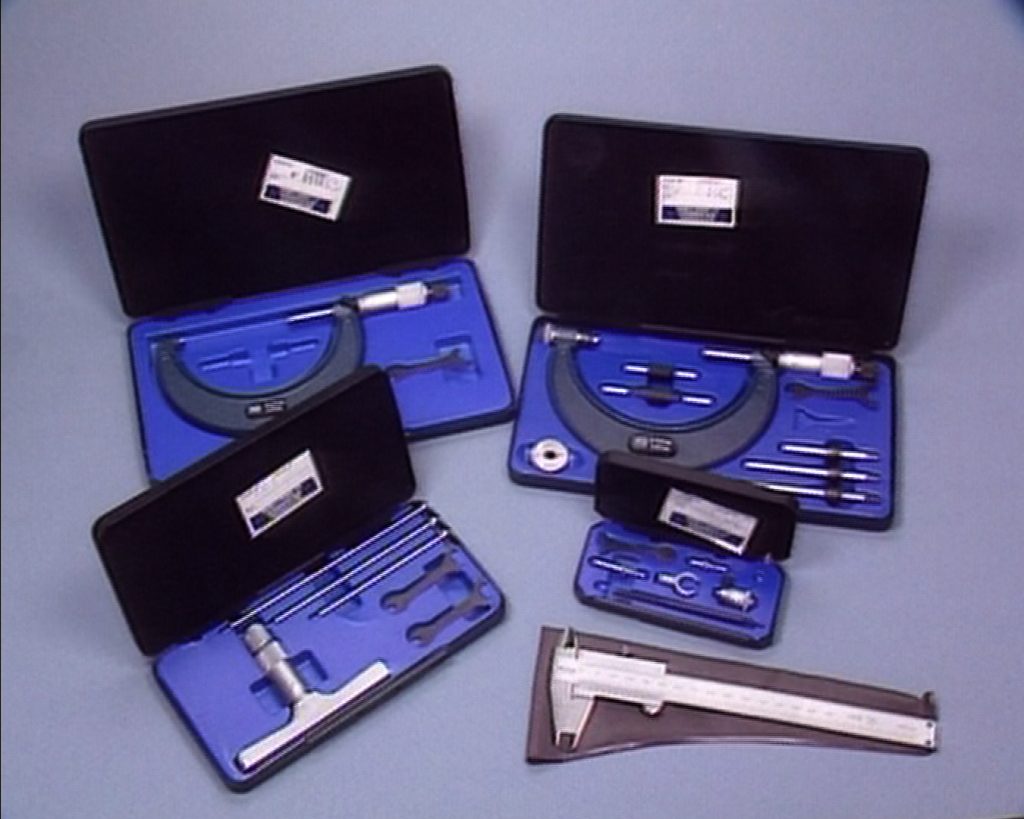
8 Modules
The complete course consists of 8 video modules and 2 PDF manuals which include self-assessment
Module 1 – An Overview of Micro-measuring
At the end of this module the learner will be able to:
• State the importance of careful measuring
• State the need for careful measuring
• Describe the standard method of expressing dimensions
Module 2 – Using & Reading Outside Micrometers
At the end of this module the learner will be able to:
• Name the parts and functions of typical micrometers
• Demonstrate the methods of holding and “feeling”
• Describe principles of reading the Main Scale
• Describe principles of reading the Thimble Scale
• Obtain an overall or combined reading
• Demonstrate the principles of maintaining Micrometers
Module 3 – Using & Reading Outside Micrometers over 25mm
At the end of this module the learner will be able to:
• Identify fixed types of Micrometers up to 100 mm
• Describe the ranges of reading with fixed types
• Check accuracy using a settling gauge
• Identify contents of adjustable micrometer kits
• Describe adjusting standards
• Use and read adjustable type micrometers
Module 4 – Using & Reading inside Micrometers
At the end of this module the learner will be able to:
• Describe typical applications
• Name the micrometer parts and functions
• Describe measuring ranges
• Demonstrate techniques of usage
• Check accuracy
• Read the instrument
Module 5 – Using & Reading Micrometer Depth Gauge
At the end of this module the learner will be able to:
• Describe typical applications
• Name the parts and functions of a typical depth micrometer
• Change extension rods
• Demonstrate handling / using techniques
• Read the instrument
Module 6 – Using & Reading Vernier Callipers
At the end of this module the learner will be able to:
• Describe typical functions
• Name the parts and functions of a typical Vernier calliper
• Describe handling methods
• Gauge external, internal and depth reading
• Read the instrument
Module 7 – Using & Reading Dial Gauge Callipers
At the end of this module the learner will be able to:
• Describe the typical functions
• Name the parts and functions of a typical dial gauge calliper
• Describe handling methods
• Gauge external, internal and depth reading
• Read the instrument
Module 8 – Using & Reading a “Dial Test Indicator” or DTI.
At the end of this module the learner will be able to:
• Describe parts and functions of a typical Dial Test Indicator
• Read a typical Dial Test Indicator (for example, 10 mm range, calibrated scale 0,01 mm)
• Set up a magnetic base / Dial Test Indicator support
• Use a Dial Test Indicator to establish lateral run-out to within 0,01 mm on a gear / sprocket facing


